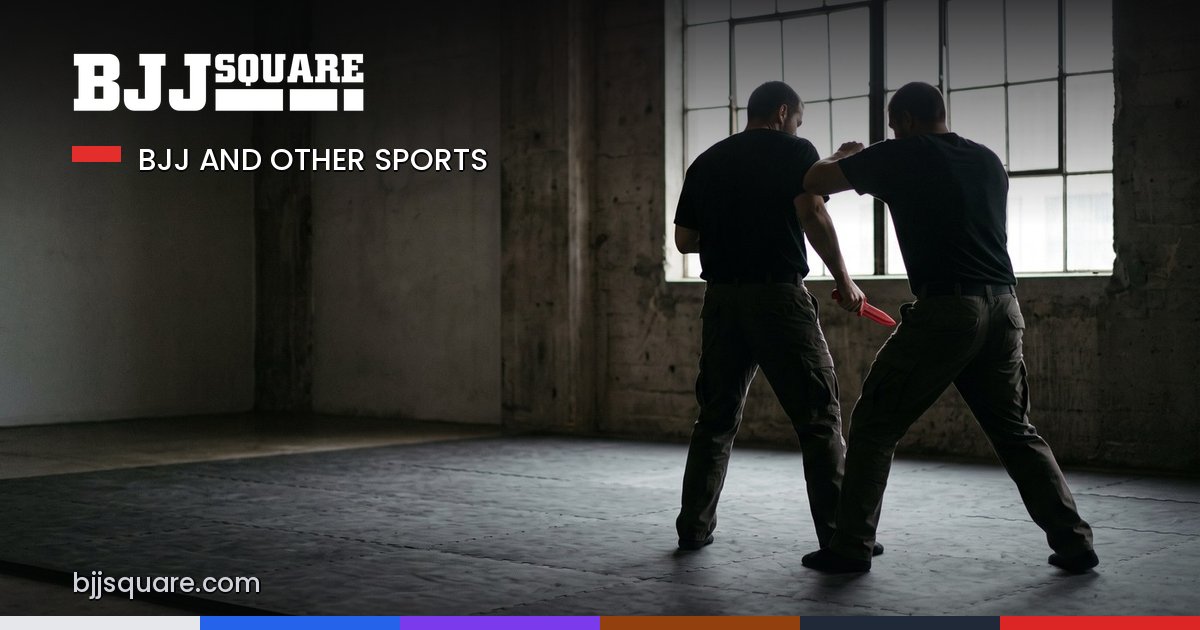
BJJ and krav maga: two answers to two different questions
They get pitted against each other constantly, and they aren't rivals: they answer different questions. The difference that matters isn't which technique "works" — it's how they train.
BJJ Square · Updated on 09/23/2026
Where they come from
Krav maga began as a military method. Imi Lichtenfeld started training Jewish paramilitary groups in Mandatory Palestine in the late 1940s, and in 1948 became chief instructor for physical fitness and krav maga at the Israeli armed forces' school of combat fitness, a role he held for about twenty years. The stated aim was to assemble effective techniques from various styles that were quickly teachable to conscripted soldiers.
Brazilian jiu-jitsu comes from somewhere else and for another reason: out of a judo school, in a context of public challenge matches, and it evolved into a sport with a rulebook, weight classes and international competition.
The difference that actually matters
It isn't the list of techniques. It's how much real resistance there is in everyday training.
In BJJ you grapple against someone genuinely trying to stop you from the first week. That's possible because every permitted technique can be applied at full force safely: your partner taps and you start again. That repetition is the one thing jiu-jitsu really offers — not the technique, but the habit of someone seriously on top of you.
In krav maga many core techniques cannot be applied at full force on a partner: eyes, throat, groin, small joints. The consequence is structural, not a fault of one gym or another. In the most widespread grading system, sparring stays slow and light until the G2 level, typically reached in four to six years.
What krav maga trains that BJJ doesn't
- Strikes, which don't exist in sport jiu-jitsu.
- Weapons: knife, stick, firearm. BJJ doesn't address them at all.
- Multiple attackers, which jiu-jitsu never covers at any point in its syllabus.
- Scenarios: environments, distance, exits, awareness of what happens before contact.
Those are exactly the things jiu-jitsu excludes in order to train everything else at full resistance. Anyone saying BJJ "covers it all" is skipping past that list.
The quality problem
Krav maga has no single governing body: there are many organisations, international and local, with curricula and grades that don't recognise one another. That makes it hard to know what you're buying until you're inside.
Jiu-jitsu has the opposite and more manageable problem: federations differ, but an instructor's rank is almost always traceable to whoever awarded it, and from there to a verifiable line of teaching. It isn't a guarantee of teaching quality, but it's one more piece of information.
How to choose, without the wrong question
"Which of the two is more effective" has no answer, because it doesn't say *at what*. Two questions do work: what do I want to train — close-quarters grappling against resistance, or scenarios, weapons and strikes — and how does that particular gym actually train, rather than the discipline in the abstract. A trial class answers both better than any argument online.
On self-defence more broadly, with the data that exists and the data that doesn't: BJJ for self-defense and what the data actually says.
Sources: the history of krav maga and its grading system from public sources on the discipline; for jiu-jitsu, the IBJJF rulebook. Where sources on krav maga diverge between organisations, we've said so rather than picking a version.
Frequently asked questions
- BJJ or krav maga for self-defence?
- They train different things: krav maga works on strikes, weapons, multiple attackers and scenarios; BJJ trains close-quarters grappling against real resistance, repeated weekly. The useful question isn't which is more effective, but what you want to train.
- Is there sparring in krav maga?
- Yes, but in the most widespread grading system it stays slow and light until the G2 level, typically reached in four to six years. That follows from the fact that many core techniques can't be applied at full force on a partner.
- Who invented krav maga?
- Imi Lichtenfeld, who trained paramilitary groups in Mandatory Palestine in the late 1940s and in 1948 became chief instructor at the Israeli armed forces' school of combat fitness.
- How do I tell whether a krav maga school is serious?
- It's harder than in BJJ, because there's no single governing body and grades aren't comparable across organisations. Look at how they actually train in the room, not at the stated curriculum.
Share this guide
We are on Instagram
The gyms on the map, the history of jiu-jitsu and the stories behind the names of the techniques.
Follow @bjjsquareRead next
- BJJ and self-defense: what actually works and what doesn'tBrazilian jiu-jitsu was born calling itself a self-defense method, and it's also the subject gym marketing shouts about the loudest. This page separates what the training actually gives you from what people selling courses promise.
- Self-defense: what the data actually says“Ninety percent of fights end up on the ground.” It's the line that sold jiu-jitsu to the world, it comes from a real study, and it doesn't say what everyone repeats. Here are the numbers, the sources, and the limits of each.