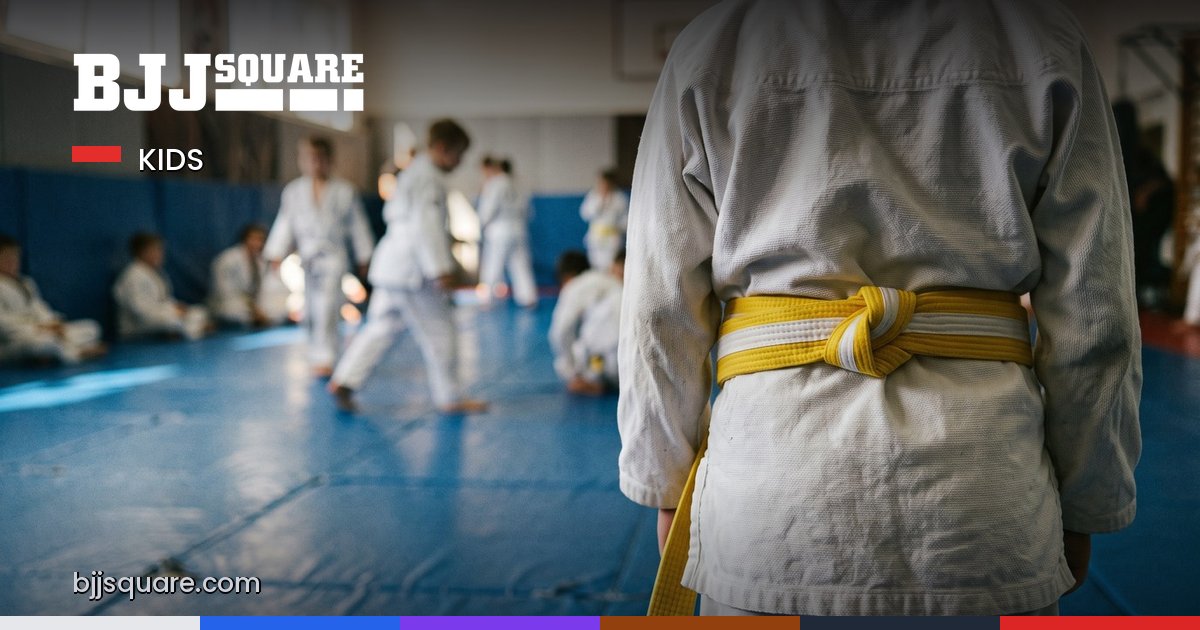
Kids' belts: twelve ranks, four colours, and what happens at 16
A child isn't a "grey belt": they're grey-white, grey, or grey-black. That's twelve ranks before sixteen — and the move to the adult system is the most delicate moment of the whole journey.
BJJ Square · Updated on 09/23/2026
Jiu-jitsu runs two separate belt systems. The adult one starts at white and reaches black in roughly a decade. The kids' one covers ages 4 to 15, has four colours and three levels per colour: twelve ranks in all.
The twelve ranks, in order
- Grey-white
- Grey
- Grey-black
- Yellow-white
- Yellow
- Yellow-black
- Orange-white
- Orange
- Orange-black
- Green-white
- Green
- Green-black
The logic never changes: colour-white, then the solid colour, then colour-black. In practice the stripe running along the belt marks the sub-level — white for the first step, none for the solid, black for the third.
The minimum ages
Each colour has an age below which it can't be awarded. It isn't a formality: it stops a gifted six-year-old from jumping three colours in a year and wearing, at eight, a belt their peers read as a title.
- Grey — from age 4.
- Yellow — from age 7.
- Orange — from age 10.
- Green — from age 13.
- The whole system closes at 15: nobody stays past that.
White has no minimum age and is where everyone starts.
How long you stay at each rank
This is the part that surprises parents: the rules set no minimum time between kids' ranks. The instructor decides. The IBJJF only *suggests* dividing each belt into degrees, and offers three alternative schemes — trimestrial (three degrees per belt), quarterly (two) or monthly (eleven). It's a suggestion, not a requirement, which is why two gyms in the same town can promote at very different rhythms without either being wrong.
What happens at sixteen
This is the move that matters, and it doesn't work the same way for everyone:
- A white belt stays white, now in the adult system.
- Grey, yellow or orange becomes blue.
- Green becomes blue or purple, at the instructor's discretion.
Note One thing to watch: an adult blue belt at sixteen isn't a prize, it's a starting line. The teenager now rolls with adults who hold the same belt and have twenty years on them, and the comparison is brutal. It's one of the moments people quit — see why so many quit at blue belt.
What a child's belt does NOT measure
It isn't comparable to an adult's: a green belt isn't "above" an adult white belt, they're two different scales. And it isn't a school grade. In serious gyms promotion takes in attendance, conduct on the mat and how the child treats their partners — not just how often they submit someone.
What to ask at the gym
- What the promotion criteria are, and how often gradings happen.
- Whether degrees between belts are awarded, and how they're marked.
- What happens when your child turns sixteen: do they stay in the kids' group to the end of the year, or move straight to adults?
- Whether the gym follows the IBJJF system or one of its own — that happens, it's legitimate, but it's better known in advance.
Source: IBJJF, *General System of Graduation*. The minimum ages and the move to the adult system are federation rules; time spent at each rank is not — the academy decides that. If you haven't picked a class yet: how a kids' course works.
Frequently asked questions
- How many belts are there for kids in BJJ?
- Twelve ranks: grey, yellow, orange and green, each in three variants — colour-white, solid colour and colour-black. White comes before all of them.
- What age can a child get a yellow belt?
- From 7. Grey starts at 4, orange at 10 and green at 13. These are federation minimums, not suggestions.
- How long does it take to move up a belt?
- The rules set no minimum time for kids' belts: the instructor decides. The IBJJF suggests splitting each belt into degrees and offers three schemes, but doesn't impose them.
- Which belt does my child get at 16?
- Grey, yellow or orange becomes blue. Green becomes blue or purple, at the instructor's discretion. A child still at white stays white in the adult system.
Share this guide
We are on Instagram
The gyms on the map, the history of jiu-jitsu and the stories behind the names of the techniques.
Follow @bjjsquareRead next
- BJJ for kids: what age to start, how it works, what to look forJiu-jitsu is one of the combat sports best suited to children, for one specific reason: there is no striking. Here is how a course actually works.
- BJJ belts: ranks, timelines and how promotions workIn Brazilian jiu-jitsu you change belt only a handful of times, and it takes a long while. It is one of the things that sets it apart from other martial arts.