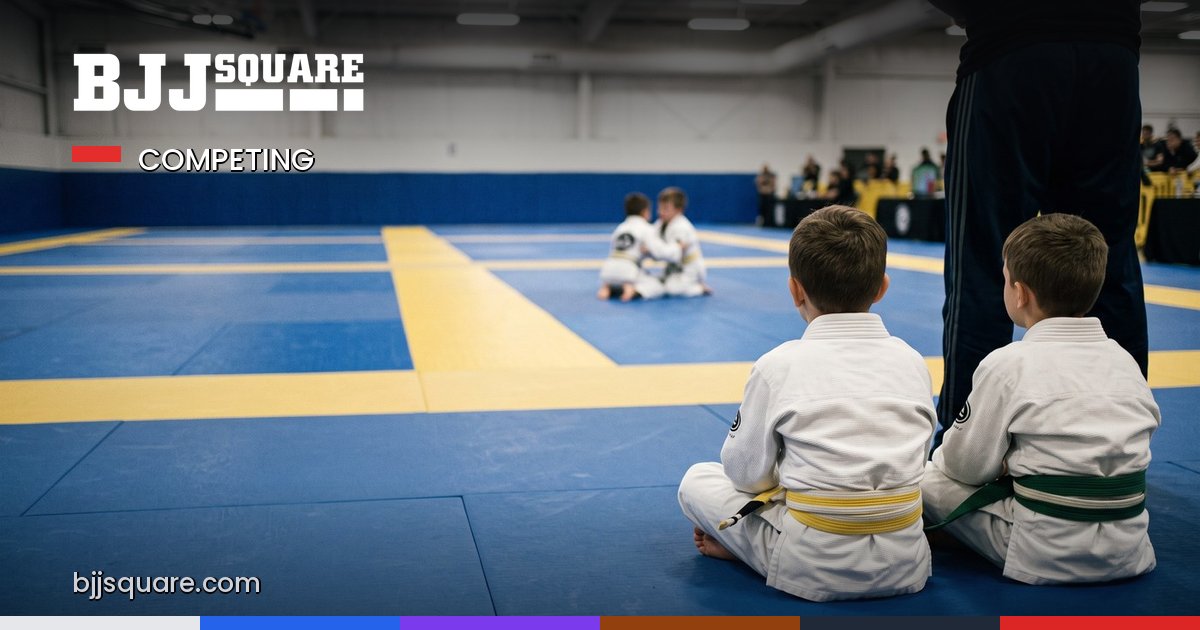
BJJ competitions for kids: divisions, match times, what's banned
A seven-year-old doesn't compete under adult rules: the match is shorter, the list of legal techniques is different, and even the penalty count changes. Here's what the rulebook actually says.
BJJ Square · Updated on 09/23/2026
This page is about IBJJF events, the most widespread circuit. If you're still deciding whether to sign your child up for classes — before any competition — the page you want is BJJ for kids.
The division doesn't depend on the birthday
This is the first thing that surprises parents: the age bracket is based on the age the child is or will be during the year of the tournament, not on their age on the day. A child born in December competes all year alongside peers born in January. The rulebook formula is literal: current year minus birth year.
Age divisions and match length
- Mighty Mite I, II, III — ages 4, 5 and 6: 2-minute matches.
- Pee Wee I, II, III — ages 7, 8 and 9: 3 minutes.
- Junior I, II, III — ages 10, 11 and 12: 4 minutes.
- Teen I, II, III — ages 13, 14 and 15: 4 minutes.
- Juvenile I and II — ages 16 and 17: 5 minutes, same as an adult white belt.
For comparison: an adult black belt fights for 10 minutes. A two-minute match is over before a parent has worked out where to look — and that's by design.
Rest between matches
The rulebook sets a minimum rest equal to the match duration of that division: two minutes for a Mighty Mite, four for a Junior. For finals the minimum doubles. It's a minimum, not a maximum: in practice the wait is almost always much longer.
What's banned under 13
From 4 to 12 the banned list is the longest in the rulebook. On top of everything that's banned for adults too — slams, spinal locks, throws landing on the head, bending fingers backwards — every leg lock, wrist lock, bicep slicer and calf slicer stays out, and so do:
- Choke with spinal lock
- Straight foot lock
- Ezekiel choke (forearm choke using the sleeve)
- Frontal guillotine
- Omoplata
- Triangle while pulling the head
- Arm triangle
- Submissions that stretch the legs apart — banned only in this bracket
From 13 to 15 the list is identical minus that last entry. At 16 the seven techniques above become legal; leg and wrist locks still wait for blue or brown belt. The full table, row by row, is in illegal techniques by belt and age.
No jumping guard
Under 15, at any rank, jumping to closed guard on a standing opponent is a serious foul — flying triangles and flying armbars included. The referee stops the match and restarts both athletes standing. If the jump happens while defending a takedown or a sweep, the opponent is also awarded 2 points.
Penalties are counted differently
For an adult, the fourth penalty means disqualification. Under 15 it doesn't: on the fourth and fifth the referee awards 2 points to the opponent and marks the penalty, and disqualification only comes on the sixth. It's worth explaining to a child before the event: one mistake doesn't end the match.
The three-athlete bracket
In the youngest divisions it often happens that only three athletes are entered. In that case it isn't straight elimination: the winner of the first match goes to the final, the loser faces the third athlete, and whoever wins that second match goes to the final. In plain terms: losing your first match doesn't send you home, and almost no child leaves after a single fight.
Note Weigh-in happens with the gi on and in a single attempt, exactly as for adults: the number on the table includes the gi. If it's the first time, read weight classes before registering.
What to say at home, beforehand
The most useful part of the rulebook, for a parent, isn't the techniques: it's the timing. Two or three minutes of fighting, a long wait, a bracket where one loss settles nothing. A child who knows in advance that they'll fight little and wait a lot arrives on the mat with a realistic picture of the day — which is half the job.
Source: IBJJF, *Rule Book* v6.1 (June 2024), articles 1, 2, 6 and 7, and *Technical Fouls & Illegal Moves*, in force since 1 January 2024. Individual tournament guidelines may add restrictions and take precedence.
Frequently asked questions
- What's the minimum age to compete?
- In the IBJJF circuit the youngest division is Mighty Mite I, for athletes turning 4 in the year of the tournament. Below that there are no federated events — at most in-house demonstrations run by the gym.
- Can my child do leg locks in competition?
- No. Up to 15 every leg lock is banned, straight foot lock included. Knee bar and toe hold unlock at brown belt, and the heel hook only for adult brown and black belts in no-gi.
- How long does a competition day really last for a child?
- The match lasts two, three or four minutes depending on age, but the day lasts hours: registration, weigh-in, gi check and waiting. The rulebook only sets the minimum rest between matches, never the maximum.
- If they lose the first match, are they done?
- Not necessarily. In three-athlete brackets — common in the youngest divisions — the loser of the first match faces the third athlete and can still reach the final.
Share this guide
We are on Instagram
The gyms on the map, the history of jiu-jitsu and the stories behind the names of the techniques.
Follow @bjjsquareRead next
- BJJ for kids: what age to start, how it works, what to look forJiu-jitsu is one of the combat sports best suited to children, for one specific reason: there is no striking. Here is how a course actually works.
- Illegal techniques by belt and age: the IBJJF table“What belt can do a toe hold?” is the question that gets five different answers in any gym. The real answer is a six-column official IBJJF table, and this is it.