The gi in competition: the measurements that fail the check
Two centimetres. That is the tolerance between the wrist and the end of the sleeve, and every year it sends home people who had trained six months for that competition.
BJJ Square · Updated on 08/11/2026
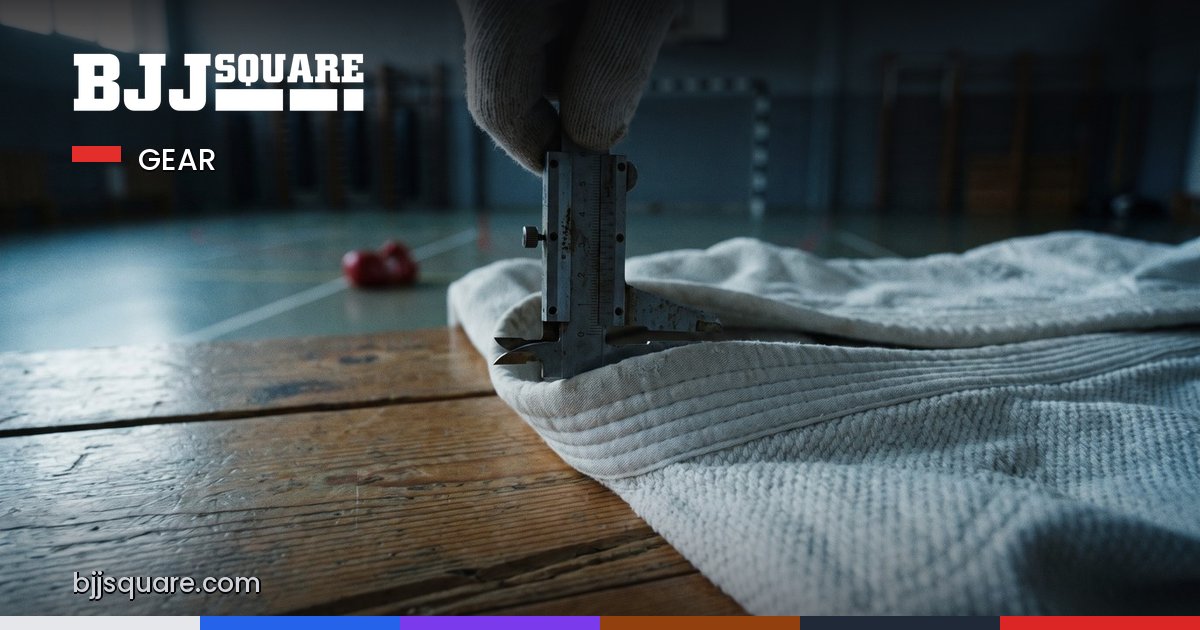
Before you step onto the mat there is a uniform check, carried out with a measuring tool. It is not a formality: the measurements are precise to the centimetre and anyone who does not meet them does not compete. What follows is the IBJJF rulebook in the edition in force as we write, the June 2024 one.
The colours
Three only: white, royal blue, black. And the rulebook is explicit on a point that surprises many: jacket and trousers must be the same colour. In so many words, no gi is accepted with a jacket and trousers of different colours. That also rules out the contrast collar and navy blue, which is not royal.
The measurements that get taken
- Sleeves: at most 2 cm from the wrist, measured with the arm extended parallel to the floor. It is the measurement that claims the most victims, because the gi shrinks with washing.
- Trousers: at most 2 cm above the ankle bone.
- Thickness of the collar lapel: maximum 1.3 cm.
- Width of the collar: 5 cm.
- Sleeve clearance: 7 cm, and not only at the wrist — along the whole length of the arm.
Note You are entitled to three uniform inspections. It is not a real safety net, though: after the weigh-in you cannot change gi for your first match, so the second kimono in your bag is only any use if you present it at the right check.
The belt
It has its own measurements too: 4-5 cm wide, in the colour of your rank, with a black tip — white or red for black belts. It is worn over the jacket, wrapped twice round the waist, closed with a double knot, and the two tails must hang between 20 and 30 cm.
Patches
The rulebook says they may sit only in the authorised areas — shown by illustrations in the document — that they must be cotton and sewn on, and that any coming unstitched or out of place get removed. There is only one explicit numerical measurement: the manufacturer's label on the front of the trousers, maximum 36 cm².
Careful ⚠️ The patch measurements in centimetres that you find everywhere online — 10×10 on the chest, 30×10 on the back — are not in the IBJJF rulebook. They are third-party reconstructions, presented as an “industry standard”. If you are having patches sewn on for a competition, ask the organisation to confirm, not a blog.
What fails the check besides the measurements
The rulebook is blunt: the gi may not show repairs or tears, be wet or dirty, or give off a bad smell. And there is a detail that concerns everybody: under the jacket, men may not wear a T-shirt, women must wear an elasticated top or a swimsuit; for everybody, briefs-type underwear is compulsory.
In another circuit the same measurements change
At AJP tournaments the tolerance on sleeves and trousers is 5 cm instead of 2: two and a half times more permissive. Collar, belt and colours, by contrast, stay identical. It means that a gi that is perfectly legal in one circuit can be failed in the other — and that the right question before buying is not “is it legal?”, but “legal by whose rules?”.
The differences between the circuits, one by one: IBJJF, ADCC, AJP.
Frequently asked questions
- What colour must the gi be at an IBJJF competition?
- White, royal blue or black, with jacket and trousers the same colour. Kimonos with a jacket and trousers of different colours are not allowed, nor are contrast collars.
- How long must the sleeves of the gi be?
- In the IBJJF rulebook they must reach at most 2 cm from the wrist, measured with the arm extended parallel to the floor. At AJP tournaments the tolerance is 5 cm.
- How many times can the uniform check be repeated?
- The IBJJF rulebook allows three inspections. Bear in mind, though, that after the weigh-in you are not allowed to change gi for your first match.
- Where can patches go on the gi?
- Only in the authorised areas shown by the rulebook's illustrations, sewn on and in cotton. The measurements in centimetres circulating online are not in the IBJJF text: the only explicit numerical limit concerns the manufacturer's label, maximum 36 cm².
- Can a dirty gi be turned away?
- Yes. The rulebook explicitly bans kimonos that are wet, dirty, torn or repaired, or that give off a bad smell.
Share this guide
We are on Instagram
The gyms on the map, the history of jiu-jitsu and the stories behind the names of the techniques.
Follow @bjjsquareRead next
- How to choose your first giThe first piece of advice is not to buy one straight away. The second is that almost everything you read about choosing the fabric counts for less than how it fits you.
- IBJJF, ADCC, AJP: who runs what, and why the rules changeThere is no such thing as “the jiu-jitsu rulebook”. There are different organisations with different ideas about what ought to be rewarded — and the differences are not details.
- How to wash the gi so it lasts (and how much it shrinks)There is one thing all the manufacturers agree on, and it is the one almost nobody follows: the gi does not go in the tumble dryer.