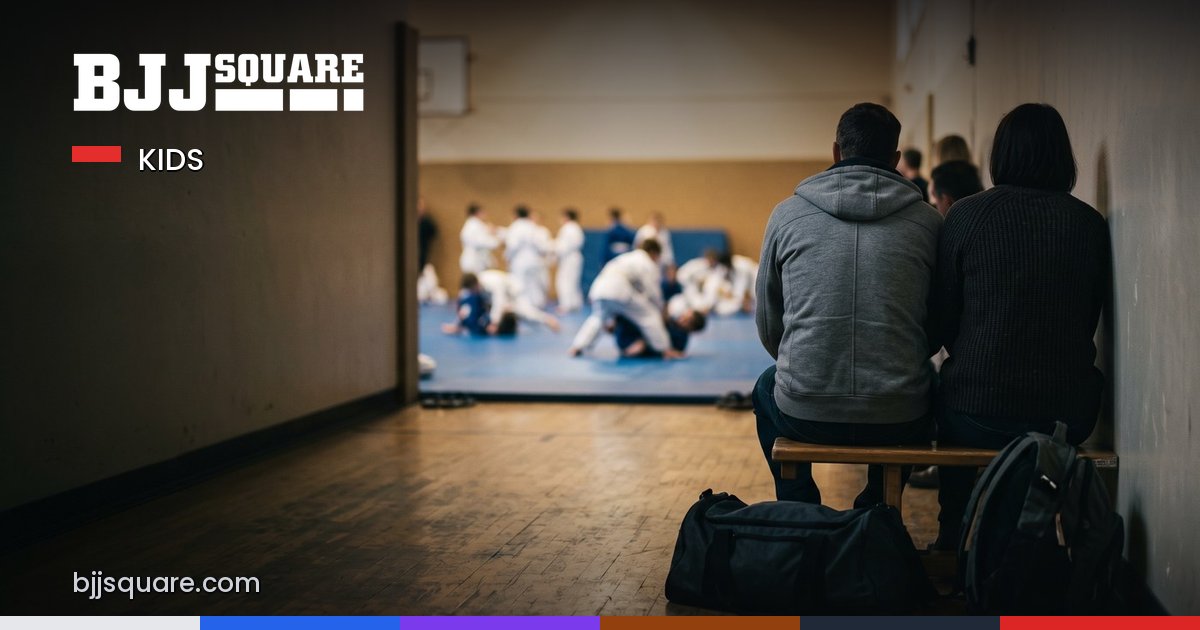
Parents at the edge of the mat: what helps, what doesn't, and when to step in
Nobody tells you how to sit at the edge of a mat. Yet it's the part of the class that depends entirely on you — and the only one where you can do harm without noticing.
BJJ Square · Updated on 09/23/2026
Careful ⚠️ There's no research on this: what follows is shared practice from people who teach children, not scientific evidence. We give it as exactly that. Where data does exist — bullying, injuries — you'll find it in the dedicated guides.
The three things instructors ask for most
- Don't coach from the sideline. A child looking for their parent's eyes while the instructor is talking is listening to one person, and it isn't the instructor.
- Don't review the performance the moment they step off. The first two minutes after a round are for breathing, not for being assessed.
- Don't compare them to the other children, not even to encourage them. "Look how well Marco does it" is the sentence that turns a training partner into a measuring stick.
Why they sometimes ask you not to watch
Many gyms ask parents to stay away from the mat, at least for the first few weeks. It isn't about hiding anything — and it's right to check, see below. It's because a child being watched by a parent behaves differently: they slow down when they get something wrong, they look to the stands when it's going badly, and above all they stop trying things they might look bad doing. In a room where nobody is watching them with that expectation, they try more.
A serious gym tells you when you can watch — open classes, gradings, one day a month — and always lets you see the room before you sign up. If the answer is "parents never come in, for any reason", that's a different thing and worth asking about directly.
What to say in the car afterwards
The question almost everyone asks is "how did it go?", which in an eight-year-old's head sounds like "did you win?". Starting somewhere else works better: what did they teach you today, who did you train with, what worked. It's a small difference that changes what the child takes home — whether the value of the hour depends on the result or on having tried.
And one thing worth saying out loud, early: tapping is not losing. It's the gesture that makes the whole sport safe, and a child who experiences it as defeat will sooner or later get hurt rather than do it. More here: tapping early.
Competition day
Everything above applies, multiplied. Add only that a competition day is nearly all waiting, and that in the youngest divisions losing the first match almost never sends you home: how kids' competitions work.
At the edge of the mat, the only useful thing to say is their name, calmly. Technical instructions shouted from three metres arrive late and drown out the coach.
When you should step in
There's a difference between letting them get on with it and not looking. These are the signals that deserve a direct question to the instructor, straight away:
- Unsupervised sparring, or one adult for twenty children of widely different ages.
- Your child regularly paired with someone much bigger or heavier.
- Coming home with bruises or pain regularly — not once, which happens in a contact sport, but as a pattern.
- An instructor who humiliates a child in front of the group, even jokingly.
- Your child not wanting to go any more and not being able to say why, or avoiding one particular training partner.
"I don't want to go any more"
Before deciding, it's worth working out which of three things it is: I don't enjoy it any more, it's too hard, or there's someone there I feel bad around. Different problems, different answers — and only the last one is urgent.
For the rest, what usually works is finishing the cycle already started — the month, the term — and deciding at the end, calmly. Forcing a child to keep doing a contact sport they don't want doesn't make them tougher: it makes them someone who has learned their opinion doesn't count.
If you still have to choose where to sign up, the questions to ask are here: BJJ for kids.
Frequently asked questions
- Can I stay and watch my child's class?
- It depends on the gym. Many discourage it in the first weeks because a child watched by a parent tries fewer things and freezes when they get something wrong. A serious gym will still tell you when you can watch and let you see the room before you enrol.
- What do I say when they come off the mat?
- Better to start from what they learned and who they trained with than from how it went. In a child's head, "how did it go?" sounds like "did you win?".
- My child comes home with bruises — is that normal?
- The odd bruise happens in a contact sport. A pattern doesn't: if it's every week, or there's recurring pain, that's a question for the instructor right away, along with how pairs are made.
- Should I insist if they don't want to go any more?
- First work out which of the three it is: they've stopped enjoying it, it's too hard, or there's a partner they feel bad around. Only the last is urgent. For the others, finish the cycle already paid for and decide at the end, without forcing it.
Share this guide
We are on Instagram
The gyms on the map, the history of jiu-jitsu and the stories behind the names of the techniques.
Follow @bjjsquareRead next
- BJJ for kids: what age to start, how it works, what to look forJiu-jitsu is one of the combat sports best suited to children, for one specific reason: there is no striking. Here is how a course actually works.
- BJJ competitions for kids: divisions, match times, what's bannedA seven-year-old doesn't compete under adult rules: the match is shorter, the list of legal techniques is different, and even the penalty count changes. Here's what the rulebook actually says.