The belt: how it is tied, and why the story that you never wash it is false
The white belt that turns black through years of training is a good story. It is not true, and to see why you need only look at the colour that comes after white.
BJJ Square · Updated on 08/11/2026
Sooner or later somebody at the gym tells it: the belt is never washed, because the rank is supposedly the dirt accumulated over years on the mat — the white one darkening until it turns black. It is a story that goes round every martial art, and it does not survive examination.
The colour that disproves it
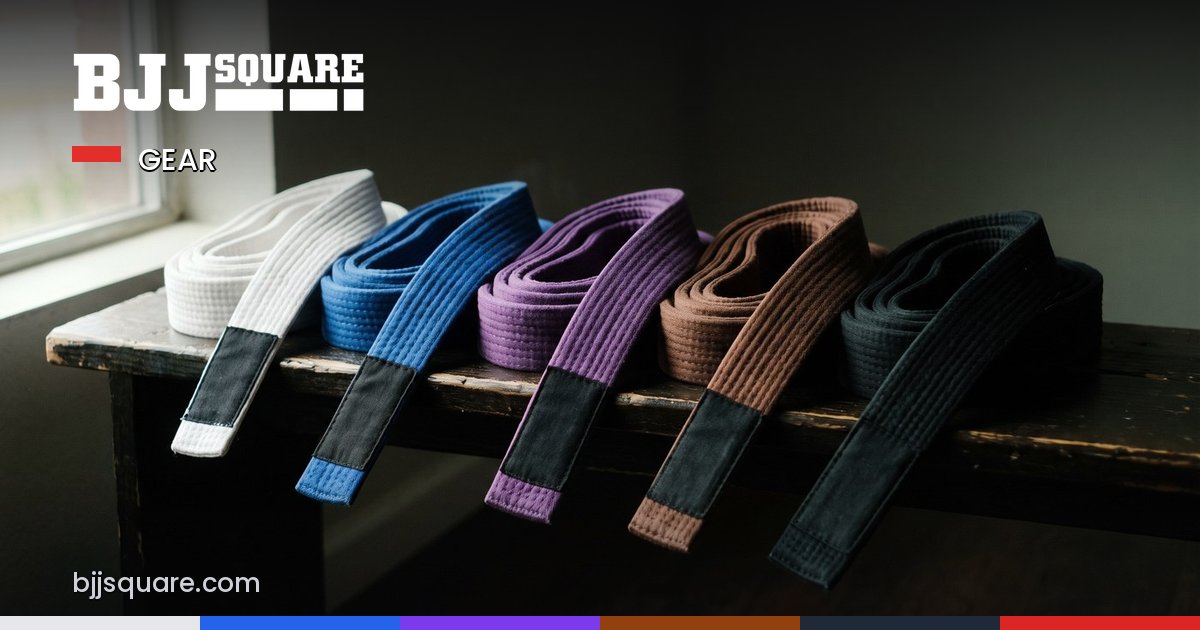
In Brazilian jiu-jitsu the adult order of rank is white, blue, purple, brown, black. Dirt does not produce blue, and certainly not purple. Belts are industrially dyed, each in its own colour. That alone settles it.
And history does not say so either
The documented reconstruction is a different one. The belt appears in late nineteenth-century judo as a functional item: it served to hold the jacket closed, since the jacket had no buttons. The black belt appears as a deliberate marker of rank around 1886, and the intermediate colours are a twentieth-century invention, and a European one at that: introduced at the Budokwai in London in 1926, then systematised in France in 1935 as part of a teaching method.
Note The International Judo Federation itself, when it cites the legend of the progressive blackening, presents it as a story that “may appeal to younger people” — not as its own historical reconstruction.
The most likely origin of the superstition is another belief: that the belt holds the knowledge you have accumulated, and that washing it takes that away. It is an idea that predates microbiology by a good margin.
Why washing it is worth doing anyway
The belt spends hours against the mat, on you and on your training partners, and then ends up in a closed bag. In grappling, skin infections are a real and documented problem: a systematic review of wrestlers reports a pooled prevalence of tinea gladiatorum of 34%, and among the risk factors identified is not washing your kit at least once a week.
Careful ⚠️ Honesty about what we do not know: no study has ever cultured bacteria or fungi from jiu-jitsu belts. Claims along the lines of “your belt is full of staph” are plausible by analogy, not measured. The real point is not the microbiological scare: it is that the belt is a piece of sweaty cloth, and there is no historical reason to treat it differently from the rest.
There is a practical argument too, for anyone who competes: the rulebook bans uniforms that are dirty or that give off a bad smell, and the belt is part of the uniform and gets inspected. A belt that has never been washed is, literally, outside the rules.
How it is tied
There is no official knot. The IBJJF rulebook prescribes only the result: a belt 4-5 cm wide, worn over the jacket, two turns round the waist, a double knot, and the tails hanging between 20 and 30 cm.
- Find the middle of the belt and hold it against your navel.
- Take the two ends behind your back, cross them and bring them back to the front.
- Pass the upper end under both turns and pull it upwards.
- Finish with a double knot, checking that the two tails stay the same length.
From there the variations are many and each carries the name of the gym that teaches it. The only practical constraint, beyond the measurements, is that the rank stays visible.
How the ranks work and how long they take: BJJ belts explained.
Frequently asked questions
- Is it true that a BJJ belt is never washed?
- No, it is a legend. The progression of rank goes through blue and purple, colours that dirt does not produce, and belts are industrially dyed. Historically the intermediate colours were introduced in London in 1926 and systematised in France in 1935.
- Is there an official knot for the belt?
- No. The IBJJF rulebook prescribes only two turns round the waist, a double knot and tails hanging between 20 and 30 cm. The most widely taught knot is the flat one, but there are many variations.
- How long should the belt be?
- The two tails must hang between 20 and 30 centimetres after the double knot, and the band must be 4-5 cm wide.
- Why does it matter to wash grappling kit?
- Because skin infections in grappling are documented: a review of wrestlers reports a prevalence of tinea gladiatorum of 34%, and not washing your kit at least once a week is among the risk factors identified.
Share this guide
We are on Instagram
The gyms on the map, the history of jiu-jitsu and the stories behind the names of the techniques.
Follow @bjjsquareRead next
- BJJ belts: ranks, timelines and how promotions workIn Brazilian jiu-jitsu you change belt only a handful of times, and it takes a long while. It is one of the things that sets it apart from other martial arts.
- How to wash the gi so it lasts (and how much it shrinks)There is one thing all the manufacturers agree on, and it is the one almost nobody follows: the gi does not go in the tumble dryer.
- How to choose your first giThe first piece of advice is not to buy one straight away. The second is that almost everything you read about choosing the fabric counts for less than how it fits you.