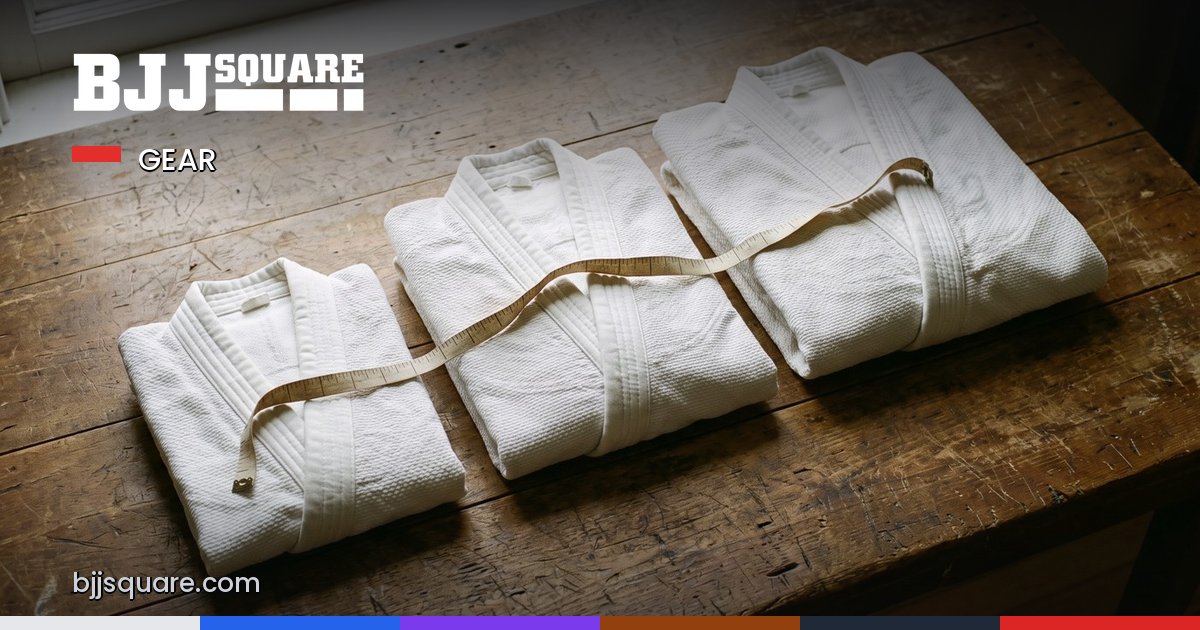
Gi sizes: why your A2 is not the same as another brand's
There is no standard. The very same A2 label, on two different brands, can fit people who differ by fifteen centimetres.
BJJ Square · Updated on 08/11/2026
Adult kimonos use a scale running from A0 to A5 — with A00 and A000 for the smallest builds. It looks like an orderly sizing system. It is not: no body defines it, and every manufacturer publishes its own chart.
The proof that it is not a standard
Take somebody 185 cm tall. On the chart of one very widespread manufacturer they fall between A3 and A4. Another manufacturer shows its own A2 model worn by an athlete of 185 cm and 74.5 kg. Same code, two sizes apart.
Careful ⚠️ The practical consequence is a single one: never order “your size” without opening the chart of that specific brand. And not even between models from the same brand: the more fitted lines have charts of their own.
How to read a chart, in practice
The working rule manufacturers state is this: weight decides the jacket, because it determines how it wraps the torso; height fine-tunes sleeves and trousers. If height and weight send you to two different sizes, the most common advice is to take the larger, because cotton then shrinks.
- A1 — roughly 165-170 cm, 70-77 kg
- A2 — 170-178 cm, 77-86 kg
- A3 — 178-188 cm, 86-102 kg
- A4 — 185-193 cm, 104-118 kg
Note These numbers come from the metric chart of one specific manufacturer and serve only to give an order of magnitude. Do not use them to buy: use the chart of the brand you are looking at.
The letters after the number
The A0-A5 system has a structural flaw: it has only one dimension, and bodies do not. Manufacturers compensate with suffixes, and one brand goes as far as offering four versions of the same size.
- L (Long) — same width, longer sleeves and legs: for those who are tall and lean.
- H (Husky) — wider across the chest and shoulders without lengthening the legs.
- F (Fitted) — a closer cut.
- There are also intermediate sizes such as A1.5 and A2.5.
Women's sizes
Many brands use an F0-F5 scale with a dedicated cut — narrower shoulders, a taken-in waist — but the women's scale is even less uniform than the men's: on a single chart two adjacent sizes can differ by one inch of height and seven kilos. Other brands do not make a women's line and sell the A sizes with a unisex fit.
Children: not even the codes coincide
Here the confusion is at its worst, because not even the code is standardised: one manufacturer uses C000-C3, another K1-K5, others again M or J. Some charts give age, height and weight; others only age and height.
Careful ⚠️ Be wary of the charts of general retailers: we found one listing “children's” sizes with heights up to 183 cm and 109 kg — evidently copied badly from an adult chart. The source to look at is always the manufacturer of the kimono, not the shop reselling it.
Once the size is chosen, the factor that changes it is washing: how much a gi shrinks.
Frequently asked questions
- What do A1, A2, A3 mean in gi sizes?
- It is the adult size scale, from A0 to A5. It is not a standard: every manufacturer publishes its own chart, and the same code can correspond to very different builds.
- How do I choose the gi size between height and weight?
- Manufacturers indicate that weight determines the jacket and height fine-tunes sleeves and trousers. If the two figures lead to different sizes, the most widespread advice is to take the larger, because cotton shrinks.
- What do the letters L, H and F after the size mean?
- They are cut variants: L (Long) lengthens sleeves and legs, H (Husky) widens the chest and shoulders, F (Fitted) is closer-fitting. They exist because the A scale has only one dimension.
- Are children's gi sizes standard?
- No, and neither are the codes: some brands use C000-C3, others K1-K5, others M or J. The manufacturer's chart should always be consulted.
Share this guide
We are on Instagram
The gyms on the map, the history of jiu-jitsu and the stories behind the names of the techniques.
Follow @bjjsquareRead next
- How to choose your first giThe first piece of advice is not to buy one straight away. The second is that almost everything you read about choosing the fabric counts for less than how it fits you.
- How to wash the gi so it lasts (and how much it shrinks)There is one thing all the manufacturers agree on, and it is the one almost nobody follows: the gi does not go in the tumble dryer.
- The gi in competition: the measurements that fail the checkTwo centimetres. That is the tolerance between the wrist and the end of the sleeve, and every year it sends home people who had trained six months for that competition.