How a BJJ competition works, from entry to medal
A competition day is 90% waiting and 10% jiu-jitsu. Knowing how it works takes away almost all the first-time nerves.
BJJ Square · Updated on 08/11/2026
People who have never competed picture a competition as a series of matches. In reality it is a long day in which you sit around for hours, warm up twice, and fight for five or six minutes in total. The hard part to manage is not the opponent: it is the waiting.
Before: entry and division
You enter online, weeks beforehand, choosing belt, age group and weight class. You choose the division at that moment, and in the major circuits you cannot change it on the day of the competition: anyone who realises they are over weight that morning has no second option.
The rules vary from organisation to organisation. At the IBJJF, the most widespread body in jiu-jitsu with the gi, changes are made online only, by a deadline stated on the event page.
On the day: arrival, weigh-in, bullpen
- You arrive early, well before the estimated time for your division. Published times are indicative: a tournament can fall hours behind or make time up.
- You wait for the call. Divisions are called in waves towards the holding area — what in English is known as the *bullpen*.
- You go through the weigh-in, which at IBJJF tournaments happens *immediately before your first match*, with the kimono on and with one attempt only.
- You warm up and you fight. Between one match and the next, ten minutes or an hour can pass, depending on how many people are in the bracket.
- You wait for the Open Class, if you want to enter it: at IBJJF tournaments you enter the Open Class on site, straight after the medal ceremony for your own division, and it is reserved for those who made the podium.
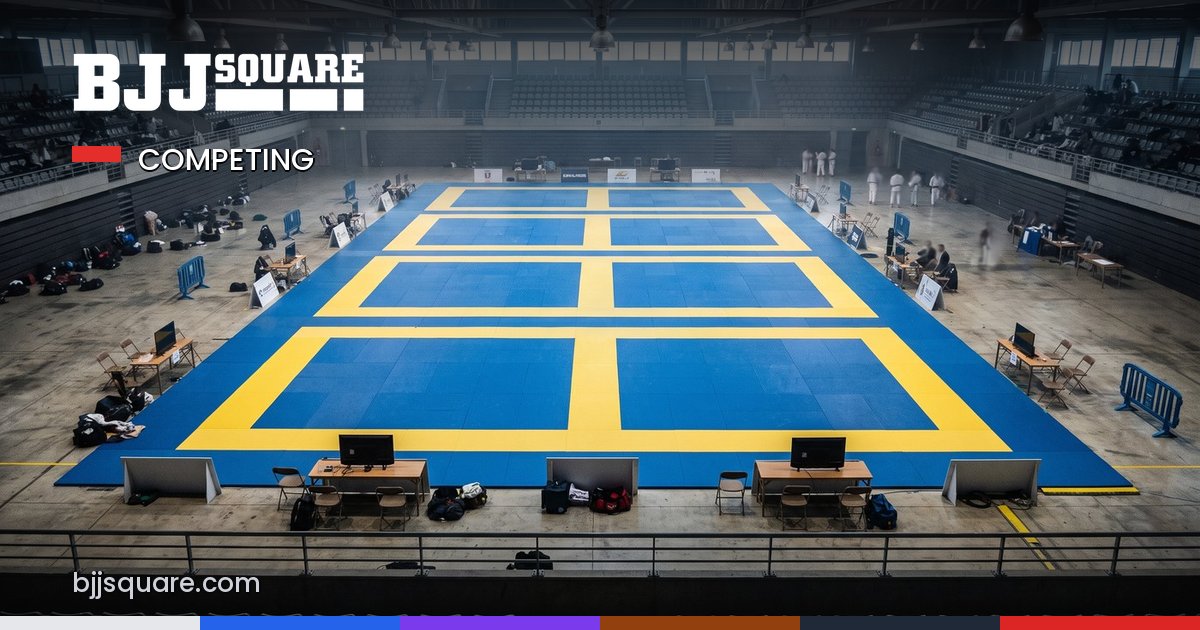
Note The thing that surprises everybody the first time is how little you actually fight. A white belt match lasts five minutes, and in an eight-person bracket it takes three matches to reach the final: fifteen minutes of jiu-jitsu spread across eight hours in a sports hall.
How you win
A match ends in three ways: submission — and then the clock does not matter — points at the end of regulation, or a referee's decision when everything else is level. Points are earned by reaching controlling positions and holding them for three seconds; we cover it here: How points are counted.
What nobody tells you
- The first match goes by in a flash. Almost everybody remembers little of their first competition: adrenaline compresses your sense of time.
- Losing in the first round is normal, and in many brackets it means your day is over in five minutes. It is not a waste: it is the reason the second competition always goes better than the first.
- People eat badly and drink too little, because they are afraid of weighing heavy before the weigh-in. It is why so many arrive at their second match empty.
If you have not yet decided whether to do one, the real question is not whether you are ready: it is when a first competition makes sense.
See the upcoming competitionsFrequently asked questions
- How long does a day of BJJ competition last?
- As a rule the whole day: you arrive hours before the estimated time for your division, because schedules slip easily. Actual fighting time, by contrast, comes to a few minutes.
- How many matches do you have at a competition?
- It depends how many people are in your division. In an eight-person bracket it takes three matches to reach the final; in a division with two entrants you have only one.
- Do you have to be a blue belt to compete?
- No. There are white belt divisions in every circuit, and it is by far the level with the most entrants.
- Can you change weight class on the day of the competition?
- At IBJJF tournaments, no: changes are made online by a deadline stated on the event page. Other organisations have different rules.
Share this guide
We are on Instagram
The gyms on the map, the history of jiu-jitsu and the stories behind the names of the techniques.
Follow @bjjsquareRead next
- Points in BJJ: what each position is worth, and what advantages areTwo points for the takedown, three for the pass, four for the mount. But the rule that decides the most matches is none of these: it is the three seconds.
- BJJ weight classes, and why you weigh in with your kimono onThe number you read in the table is not your weight: it is your weight with the kimono on. It is the mistake that costs the most disqualifications at a first competition.
- The first competition: when it makes sense, and how you actually prepareNobody feels ready for a first competition, and waiting to feel ready is the best way never to do one. The useful question is a different one.
- What to put in your bag on competition dayYou will spend far more hours in that sports hall than you will on the mat. Pack the bag for the waiting, not for the five minutes of matches.