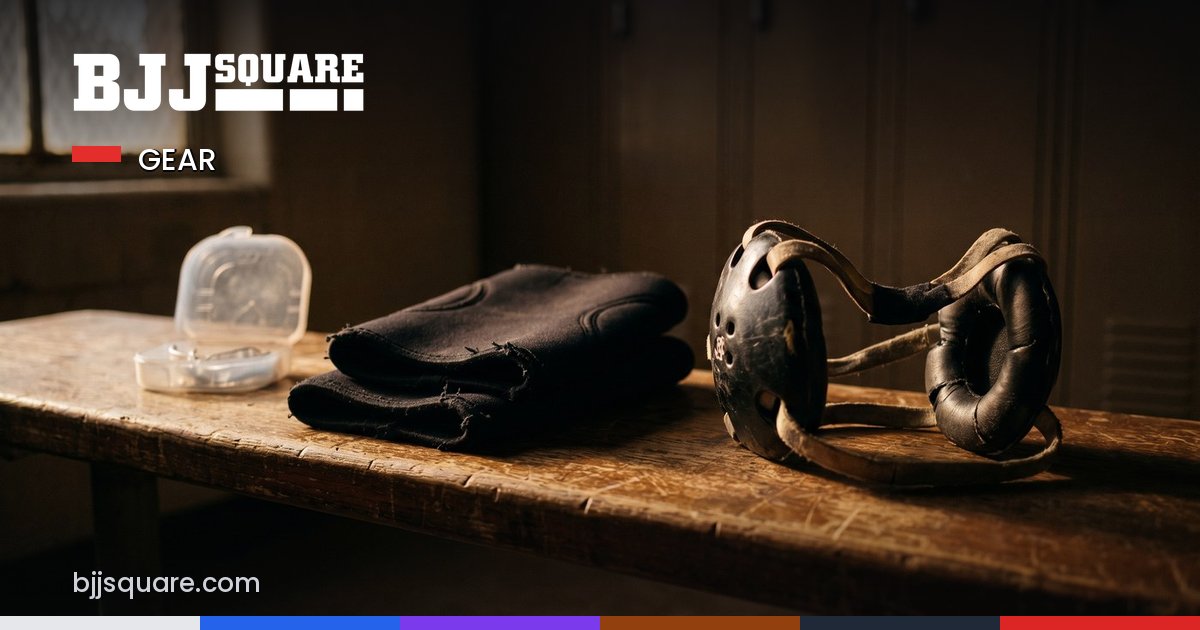
Mouthguard, knee pads, ear guards: what you need and what is allowed
There is one piece of protection the evidence supports and the rulebook bans, and one the rulebook does not even mention while the trauma data says to wear it.
BJJ Square · Updated on 08/11/2026
Jiu-jitsu uses little protective gear, far less than other contact sports. Partly because no strikes are thrown, partly because the competition rulebook bans most of it — and the logic of the ban is not safety, but stopping padding from making the kimono harder to grip.
The mouthguard: the strangest case
The IBJJF rulebook does not mention it at all. It is neither compulsory nor banned: it is tolerated by omission. Which is curious, because the data on dental trauma says something else.
A position statement from the Association of Ringside Physicians, from 2021, compares combat sports on this point. Jiu-jitsu comes out as the one with the highest prevalence of dentofacial trauma: 52.9%, ahead of boxing and wrestling, both at 45.9%. The same document reports studies in which dental trauma falls from 25.8% to 12.6% with a mouthguard.
Note The same document is blunt on two points: it recommends custom-fitted mouthguards, not preformed or “boil-and-bite” ones, and it states that effectiveness against concussion is not demonstrated. The mouthguard protects the teeth, not the brain.
Ear guards: effective and banned
Cauliflower ear comes from a haematoma which, repeated, separates the perichondrium from the cartilage and leaves it without blood supply: the tissue deforms permanently. It is not a cosmetic matter, and it is extremely widespread: in a study of national-level martial artists, 84% of the men had cauliflower ear.
Ear guards work: the literature on wrestlers reports up to 50% fewer ear haematomas. But in competition they are banned, both in the IBJJF rulebook and at the ADCC. In training they are allowed, and almost nobody wears them.
Careful ⚠️ How many people actually use them at the gym, nobody knows: there are no surveys on jiu-jitsu. That they are uncommon is a common observation, not a measured figure.
Knee pads
In competition they are allowed only if soft, with no rigid parts, and provided they do not add so much bulk as to obstruct the opponent's grip. Braces with metal hinges or rigid plastic are out. A practical detail from the rulebook: you may weigh in without knee pads, but you must be wearing them at the uniform check.
Note On the usefulness of knee pads in jiu-jitsu we found no evidence at all: everything that circulates is buying guides. It does not mean they are of no use — it means nobody has measured it, and anybody selling them to you as prevention is going beyond what is known.
What is banned in competition, full stop
- Footwear of any kind.
- Ear guards and any rigid head protection.
- Groin guards and genital protectors.
- Glasses and eye protectors.
- Jewellery, hair clips, and in general any rigid material.
- Women's head coverings, by contrast, are permitted, if made of elasticated fabric, with no plastic or laces, and tucked inside the top.
The other rules on the competition uniform: the gi in competition.
Frequently asked questions
- Is a mouthguard compulsory in BJJ?
- No, and the IBJJF rulebook does not even mention it: it is neither required nor banned. The evidence on dental trauma supports it, though, and jiu-jitsu comes out as the combat sport with the highest prevalence of dentofacial trauma.
- Can you use ear guards at a jiu-jitsu competition?
- No: they are banned both in the IBJJF rulebook and at the ADCC. In training they are allowed, and they are the only piece of protection with evidence of effectiveness against cauliflower ear.
- Are knee pads allowed in competition?
- Only if soft, with no rigid parts, and provided they do not add so much bulk as to make gripping harder. Braces with rigid hinges are not allowed.
- Do ear guards prevent cauliflower ear?
- The literature on wrestlers reports reductions in ear haematomas of up to 50% with the use of ear guards. In jiu-jitsu, however, they remain banned in competition and little used in training.
Share this guide
We are on Instagram
The gyms on the map, the history of jiu-jitsu and the stories behind the names of the techniques.
Follow @bjjsquareRead next
- The gi in competition: the measurements that fail the checkTwo centimetres. That is the tolerance between the wrist and the end of the sleeve, and every year it sends home people who had trained six months for that competition.
- Rash guard, spats and shorts: what you need for no-giYou need very little, and it costs less than a kimono. But in competition even that very little has precise rules — including the ones about pockets.
- How to choose your first giThe first piece of advice is not to buy one straight away. The second is that almost everything you read about choosing the fabric counts for less than how it fits you.