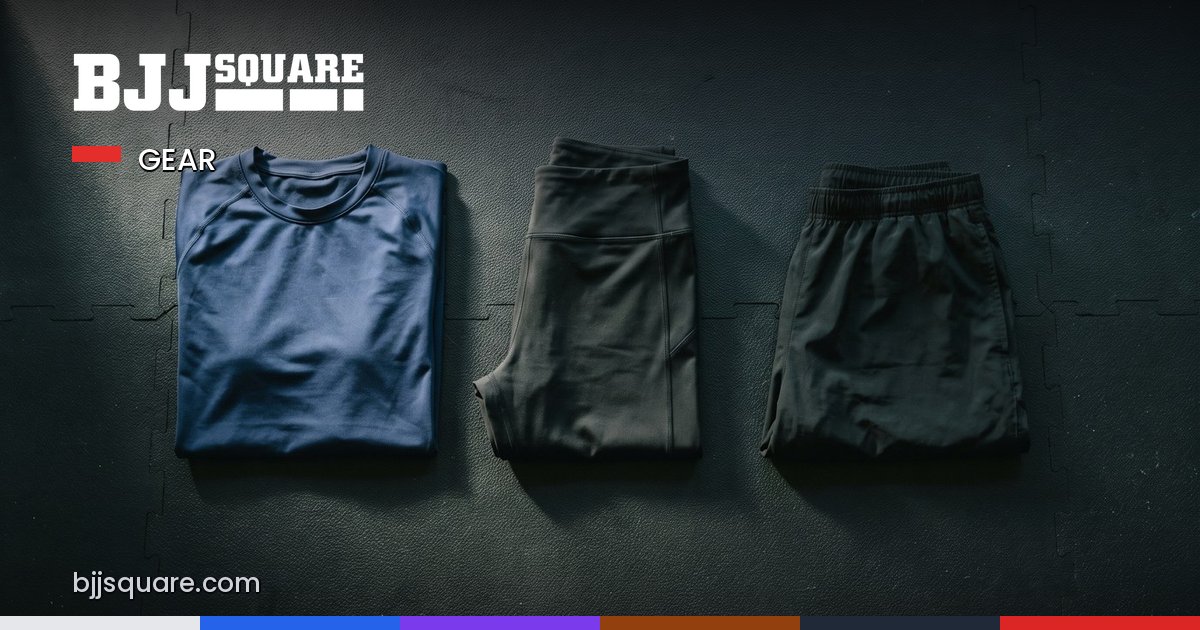
Rash guard, spats and shorts: what you need for no-gi
You need very little, and it costs less than a kimono. But in competition even that very little has precise rules — including the ones about pockets.
BJJ Square · Updated on 08/11/2026
To train no-gi all you need is a fitted top and a pair of shorts. It is the reason many gyms start beginners there: you begin with what you already own.
The rash guard
It is the tight elasticated top, in polyester and elastane. It is used for three reasons, in order of how solid they are: it acts as a barrier between your skin and the mat, it reduces friction abrasions — *mat burn* — and it manages sweat. The fourth reason you often read, the compression that supposedly aids recovery, is more a marketing argument than a finding.
Note The hygiene reason is the most solid of the three, but it has to be stated honestly: putting a layer of fabric between the skin and the mat makes sense given how skin infections are transmitted in grappling, where skin-to-skin contact and micro-abrasions are what count. There is, however, no study measuring how many fewer infections a rash guard produces.
Spats, or shorts, or both
Spats are technical leggings. Same logic as the rash guard, applied to the legs. In training they are worn on their own or under shorts, as you prefer.
In competition, though, there are rules
In the IBJJF rulebook the top must be fitted and cover the torso down to the waistband of the shorts, and the colours are limited: black, white, or black and white with at least 10% of the colour of your own belt — or a top entirely in the colour of the belt.
- Shorts with no pockets, or with the pockets sewn completely shut.
- No buttons, zips or exposed drawstrings, nor any plastic or metal parts.
- Length: at least mid-thigh, no further than the knee.
- Colours: black, white, black and white, or the colour of your own belt.
Why pockets are banned
It is not an aesthetic rule. A finger or a foot that goes into a pocket during a transition ends up bent in a direction that is not its own — that is the rationale technical clothing manufacturers state, and the rulebook confirms it by banning anything that “may represent a risk to the opponent”. Zips and buttons, in the same way, cut and scratch: and a scratch on a mat is the way in for a skin infection.
Careful ⚠️ A difference worth knowing: in the IBJJF rulebook spats on their own appear only among the women's options. Women may compete in shorts, spats or both; for men, spats go under the shorts, not instead of them.
What changes between competing with and without a kimono: competing in gi or no-gi.
Frequently asked questions
- What do you need to train no-gi?
- A fitted top (a rash guard) and a pair of shorts. Spats, the technical leggings, are optional in training.
- Why do grappling shorts have no pockets?
- Because fingers and feet can get caught during transitions, with the risk of unnatural bending. The rulebook also bans buttons, zips and exposed drawstrings, which can cut or scratch.
- What colour must a rash guard be in competition?
- In the IBJJF rulebook: black, white, or black and white with at least 10% of the colour of your own belt, or entirely in the colour of the belt.
- Can you compete in spats without shorts?
- In the IBJJF rulebook, spats worn on their own appear only among the women's options. For men they go under the shorts.
Share this guide
We are on Instagram
The gyms on the map, the history of jiu-jitsu and the stories behind the names of the techniques.
Follow @bjjsquareRead next
- Competing with the gi or without: two different sports on the same dayThe differences that look like nuances in the gym become decisive in competition: the pace changes, who controls changes, and even the weight you have to make changes.
- Gi or no-gi: the differences, and which to start withThey are the same sport played under two different rules of friction. The difference is not the clothing: it is what you can grab.
- How to choose your first giThe first piece of advice is not to buy one straight away. The second is that almost everything you read about choosing the fabric counts for less than how it fits you.
- Mouthguard, knee pads, ear guards: what you need and what is allowedThere is one piece of protection the evidence supports and the rulebook bans, and one the rulebook does not even mention while the trauma data says to wear it.